
Water from the Rock: A Guide to Natural Stone Fountains


There’s something timeless about water flowing over natural stone. It brings together two elements that already feel at home in the landscape—the strength and texture of rock with the movement and sound of water.
For Las Vegas landscapes, natural stone fountains can be especially striking. Stone complements the colors and textures of the surrounding desert, while moving water creates a refreshing contrast. Depending on the material and design, a natural stone fountain can feel rugged and organic, clean and contemporary, or elegant and architectural.
Unlike manufactured fountains designed to imitate stone, genuine granite, basalt, marble, onyx, limestone, and other natural materials have their own variations in color, texture, shape, and veining. That means every piece has its own character.
At Living Water Landscaping, a natural stone fountain can be incorporated into the complete landscape design, taking into account its placement, scale, surrounding plants, decorative rock, hardscaping, lighting, and nearby outdoor living areas.
Start with the Stone
Choosing a natural stone fountain starts with choosing the stone itself. Each material has its own personality and can completely change the character of the finished water feature.
Granite is one of the most durable choices for outdoor fountains. It can be left rugged and natural, textured, sculpted, or polished into smooth geometric forms. Depending on the stone selected, granite can range from subtle grays and blacks to warmer or more colorful variations.

Basalt has a darker, dramatic appearance and is particularly well suited to column fountains. Its naturally rugged texture and deep coloring work beautifully in both contemporary landscapes and more naturalistic designs. A group of basalt columns at different heights can create an especially impressive focal point.

Marble offers a more refined appearance. Its natural veining means the stone is visually interesting even before water begins flowing across it. Marble fountains can work especially well in landscapes with a more formal, architectural, or luxury character.

Onyx can take that visual drama even further. Its distinctive colors, patterns, and translucent qualities can turn a fountain into something closer to outdoor sculpture.

The best choice isn't necessarily the most dramatic stone. It's the material that looks as though it belongs with the architecture and surrounding landscape.
Natural Stone Fountain Styles
One of the great things about natural stone is just how many different ways it can be transformed into a fountain.
Stone columns create height and drama. Pieces of basalt, granite, or other natural stone can be drilled so water bubbles from the top and travels down their textured surfaces. A single column can provide a simple sculptural accent, while a grouping of three or more at varying heights creates additional movement and dimension.

Bubbling boulders take a more natural approach. Instead of heavily shaping the stone, a large rock or boulder can retain much of its original form while being transformed into a fountain. Water appears to emerge directly from the rock, creating the impression of a small natural spring within the landscape.

Stone spheres take the same natural material in a completely different direction. Granite and other stones can be shaped into precise geometric forms, with water bubbling from the top and flowing evenly around the surface. The combination of natural material and perfect geometry works particularly well in modern and contemporary landscapes.

Stone urns and vessels create another option. Water gently bubbling or overflowing from the top provides movement without requiring a large fountain structure. These designs can work beautifully in courtyards, near patios, beside entryways, or as part of a larger planting area.

Millstone fountains feature a broad circular stone with water emerging through the center and flowing across its surface. Their lower profile makes them useful where homeowners want the sights and sounds of moving water without blocking views across the landscape.

For something more traditional, tiered stone fountains allow water to cascade from one basin to another. They can range from relatively simple two-tier designs to substantial centerpieces appropriate for larger courtyards and estate-style landscapes.

Natural stone can also be incorporated into wall fountains and water walls. Water can emerge from a spout or scupper into a basin below or flow directly across a stone surface. These designs can create a substantial focal point without occupying as much ground space as a freestanding fountain.

The Beauty of a Recirculating Fountain
Creating a stone fountain doesn't necessarily mean adding a large exposed pond or basin to your backyard.
Many natural stone fountains can use a closed-loop recirculating system. Water flows across the stone before disappearing into a concealed reservoir underneath the feature. A pump then returns that same water to the top and the process begins again.
Decorative rock or polished pebbles can conceal the reservoir and mechanical components, leaving the natural stone and flowing water as the primary visible elements.
For Las Vegas landscapes, this can be an especially appealing approach. You get the movement, reflection, and relaxing sound of water without needing a large open body of water.
It also allows the fountain to blend naturally into decorative rock, planting beds, patios, courtyards, and other parts of the landscape.
Finding the Right Size and Location
A beautiful fountain can still feel wrong if its scale doesn't match its surroundings.
A smaller bubbling stone, urn, or sphere can be perfect for a courtyard, entryway, patio, or intimate garden area. Large boulders, tall basalt columns, and multi-piece stone arrangements need more visual space and can become major focal points within the backyard.
Placement should also consider where you'll see and hear the fountain.
A fountain near an outdoor dining or lounge area allows the sound of moving water to become part of the experience. Positioning it along a major sightline can make it visible from the patio or even from inside the home. Placing a dramatic stone feature at the end of a walkway can naturally draw the eye through the landscape and create a destination.
The Las Vegas environment should also influence the design. Full desert sun can increase evaporation, while fountains with taller streams or cascading water may experience greater water loss in exposed, windy areas. The amount of splash and water movement should therefore be considered along with appearance.
And don't forget the weight. Natural stone can be extremely heavy, particularly when working with large boulders, columns, or carved pieces. Proper site preparation and a stable, level foundation are important parts of the installation.
Design the Landscape Around the Fountain
The best natural stone fountains don't look as though they were purchased and placed in an empty corner of the yard. They look like they belong there.
A bubbling boulder can emerge from a bed of decorative rock surrounded by agaves, ornamental grasses, and desert plants. Basalt columns can rise from polished pebbles within a clean contemporary landscape. A granite sphere can become the centerpiece of a courtyard framed by pavers and architectural planting.
For an even more natural appearance, the primary fountain stone can be surrounded by additional boulders and landscaping. Done correctly, the water feature can look almost as though the rocks were already there and water simply began flowing through them.
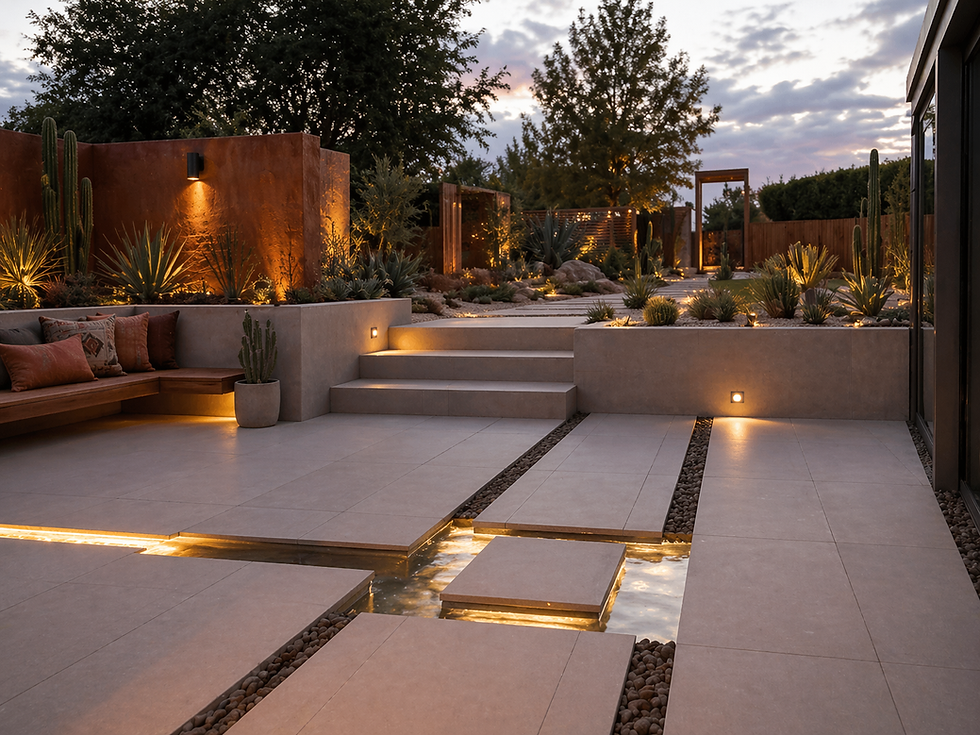
Landscape lighting adds another layer after sunset. Carefully positioned lights can reveal the texture of the stone, highlight moving water, and create reflections and shadows throughout the surrounding landscape.
The fountain can then be visually connected to nearby patios, walkways, retaining walls, pools, fire features, outdoor kitchens, and other backyard amenities.
The objective isn't simply to install a fountain. It's to design a landscape around water and stone.
See Your Stone Fountain in 3D
Natural stone fountains are highly visual features, which makes them ideal to explore through Living Water's professional 3D landscape design process.
Before construction begins, homeowners can compare potential locations, experiment with different sizes and styles, and see how the fountain interacts with surrounding hardscaping, landscaping, outdoor living areas, and other backyard features.
A group of tall basalt columns might create exactly the dramatic focal point a large backyard needs, but overpower a smaller space. A bubbling boulder may look best nestled into a planting bed, while a polished stone sphere could provide the perfect contrast against clean contemporary architecture.
The entire design can also be visualized after sunset, helping homeowners see how landscape lighting can highlight the stone, water, nearby plants, pathways, and architectural features.
Rather than selecting a fountain in isolation, 3D design allows it to become part of the larger vision for the property.
Bring Water from the Rock
Natural stone has a character that's difficult to reproduce with manufactured materials. Every variation in texture, color, shape, and veining becomes part of the finished feature—and flowing water brings those characteristics to life.
From rugged bubbling boulders and towering basalt columns to polished granite spheres, carved vessels, tiered fountains, and architectural stone water walls, natural stone can accommodate almost any landscape style.
Living Water Landscaping can help bring the entire environment together through professional 3D landscape design, natural stone water features, landscaping, hardscaping, decorative rock, landscape lighting, fire features, outdoor kitchens, and complete outdoor living design.
Whether you want your fountain to feel as though it emerged naturally from the desert or stand proudly as a piece of outdoor sculpture, start with stone, add water, and let the landscape come to life.

Comments